
Completion requirements
Lecture’s Objectives :
By the end of this lecture, students will be able to:
- Cover insights about teaching grammar.
- Elaborate the content provided critically.
Part One: Initial Steps
What is Grammar?
It denotes a set of rules and norms that conduct correct, proper and adequate use of language. It is regarded as a pillar for good language comprehension and production.
The role of Grammar:
It helps learners in reaching accuracy
Comprehension of either oral or written content
Production of correct and coherent
Scrivener 's Lesson Structure
Lead- In: the teacher provides pictures about the concerned topic then elicits ideas from students.
Teacher Clarification: the teacher elicits/ explains examples.
Restricted Output: the students work on oral/written practice of examples of these items.
Authentic Output: the students are given the opportunity to use these items along with the other language they know.
“Present-Practice” Lessons Structure (Scrivener , 2011)
Part Two: Deductive approach vs Inductive Approach (According to
Thornbury (1999))
Deductive Approach
Advantages
- It ensures straightforwardness.
- It acknowledges the role of cognitive processes.
- It fits learners with analytical learning style.
Disadvantages
- Lack of understanding the concepts.
- Less learners’ interaction and involvement.
- Learning a language is limited to learning its rules.
Inductive Approach
Advantages
- Discovering of rules make rules meaningful, memorable and serviceable.
- Ensuring cognitive depth due to the mental efforts.
- Active involvement of learners.
- Pattern recognition and problem solving abilities.
- Foster learner autonomy.
The advantages of Inductive approaches (According to Nunan, 2015)
- Stimulating a greater depth of processing.
- Students are able to be constructors of their own learning.
- It fosters independent learning skills.
"I tend to favor inductive learning because I believe that having to figure something out for ourselves stimulates a greater depth of processing than simply having it told to us". Nunan, 2015, p. 126
Disadvantages
- Rules seem to be the objective of learning not a means.
- Learners my hypothesize wrong rules.
- Heavy demands on teachers.
- Learners may prefer to receive the rule.
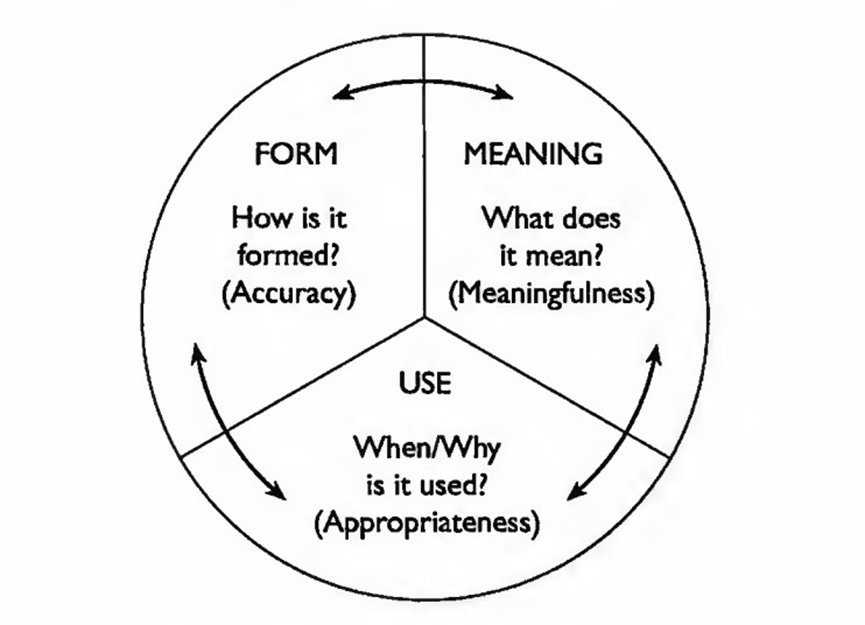
Celce-Murcia, M., & Larsen-Freeman, D. (1999) Dimensions of Grammar
Last modified: Saturday, 20 December 2025, 9:20 AM