
Completion requirements
Lecture’s Objectives :
By the end of this lecture, students will be able to
Identify teachers' roles.
Elaborate the content provided critically.
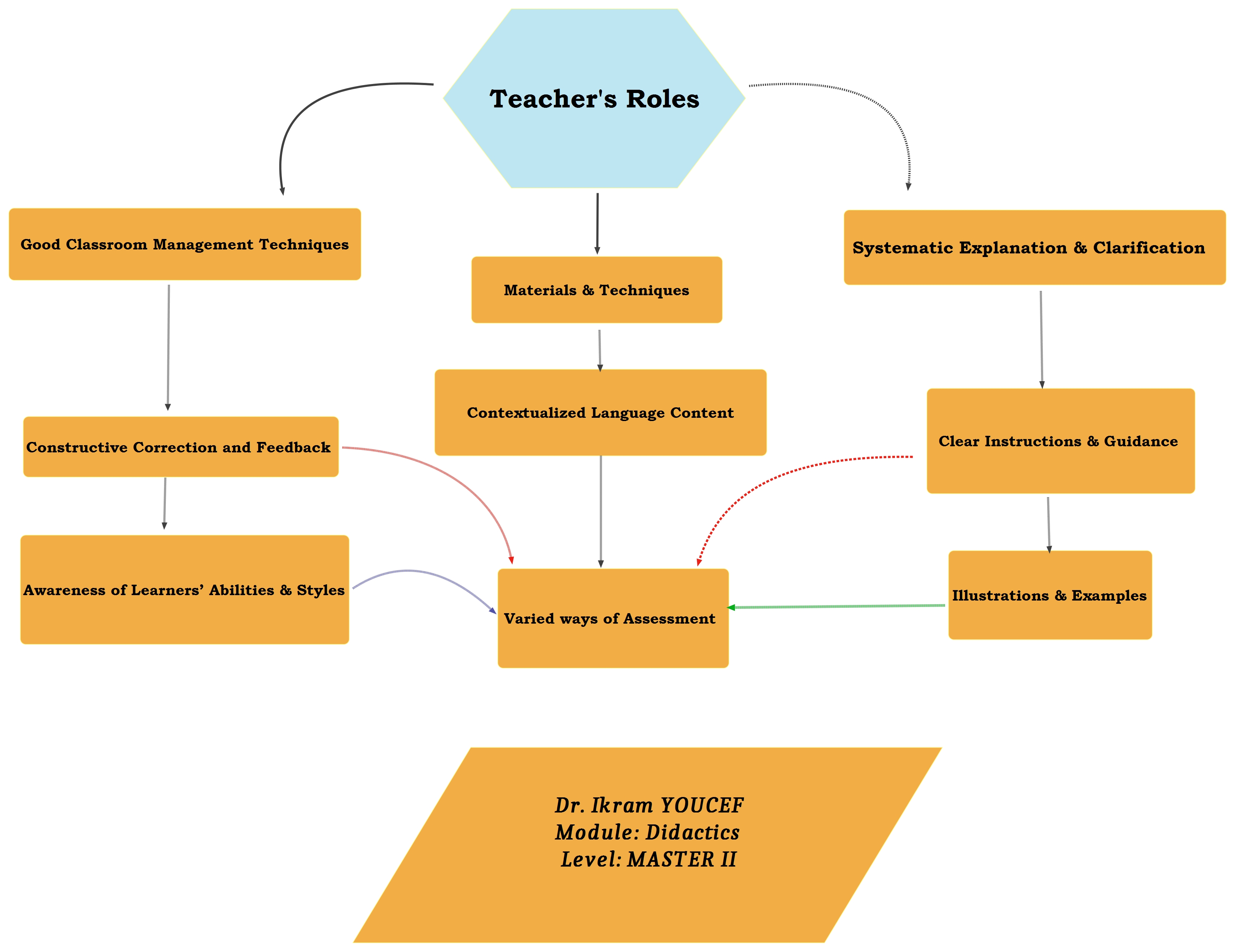
Teacher's Roles
Controller: This is considered as one of the traditional roles that teachers can play in their classrooms. They are simply in charge of setting the tone of good conduction in terms of discipline and the quality of the content taught. Acting as a controller can be of advantage when order is established, explanations are delivered and instructions are made. However, students need to have their own experiential learning (Harmer,2001, p.58) as teacher can become a source of inspiration while keeping the pace of learner –centeredness.
Prompter: In such situations, teachers can provide a share of help without fully taking part instead of learners. For e.g.: learners may be “lost for words” (Ibid, p.60). Suggesting guidance when it is truly needed without affecting learners’ creativity since they are required to deal with the problem solving situation using the clues provided according to their self- reliance.
Resource: We suppose that you have asked your learners to write a short composition about air pollution, they may ask you during the process of writing about some vocabulary. It is advisable to orient them towards external sources such as: the use of dictionary. Learners who are highly dependent on their teachers are less likely to become productive. In some circumstances acting as a resource is unavoidable.
Tutor: It can be a combination of two different roles such as: prompter and resource (Harmer,2001,p.62). As a tutor, you are supposed to have closer awareness about individuals mainly their personalities and abilities especially if they are required to prepare projects or other types of assignment.
Observer: Observation leads to constructive feedback either oral or written since the teacher can watch his/her learners in the process of performing some tasks and activities and then eventually thinks about possible alternatives as far as the content delivered is concerned. It has also a considerable share of assessment that is closely mirrored through the teacher’s performance and stands as an impetus to increase learning proficiency.
Participant: It can be possible for teachers to take part in activities so as to teach skills and knowledge implicitly. However, being too much involved can turn to become undesirable. Building good rapport with learners goes in par with discovering thoroughly their needs, lacks and even requirements. Meanwhile, the teacher can gain more dominance (Harmer, 2001, p.61) based on his intellectual superiority. This role needs to be taken proactively and wisely.
Last modified: Thursday, 20 November 2025, 8:28 PM